
When Do Roth Conversions Actually Improve Lifetime Wealth?
Two retirees begin with the same $3 million. One retires at 52 with taxable assets; the other at 63 with everything in a traditional IRA. The Roth conversion strategy that works for one does not work for the other.
Explore the Interactive Model →Roth conversions are often presented as a relatively straightforward trade: pay taxes today in exchange for tax-free growth and lower taxable distributions later.
Our modeling suggests the decision is considerably more complicated—particularly for people retiring well before traditional retirement age.
An early retiree may have more than two decades before required minimum distributions (RMDs) begin, more than a decade before Medicare eligibility, and potentially 40 or 50 years of retirement to fund. That long horizon creates competing effects.
Taxes paid for Roth conversions remove capital that might otherwise compound for decades. At the same time, traditional IRA assets left untouched can also compound for decades, potentially creating large future RMDs and tax liabilities. Early retirees purchasing insurance through the Affordable Care Act (ACA) face another complication: conversions increase income and can reduce premium subsidies.
The question is therefore not simply whether Roth conversions reduce future taxes. They generally do.
Under what financial circumstances do Roth conversions improve modeled lifetime wealth, and which variables most strongly influence the result?
To explore that question, we modeled two retirees beginning with the same $3 million of financial assets but under very different retirement circumstances. The results were strikingly different.
Two Retirees, Same $3 Million
Scenario 1 · Early retirement
Age 52
$1M taxable brokerage
$2M traditional IRA
$0 Roth IRA
Scenario 2 · Standard retirement
Age 63
$0 taxable brokerage
$3M traditional IRA
$0 Roth IRA
The brokerage account provides accessible assets during early retirement, while the traditional IRA has more than two decades to grow before RMDs begin. The 63-year-old begins much closer to RMD age and holds the entire portfolio in a traditional IRA.
For both cases, we assumed $100,000 of first-year spending increasing 3% annually, a 7% nominal investment return, married filing jointly, Florida residency, $50,000 of annual household Social Security beginning at 67, and a modeling horizon through age 100.
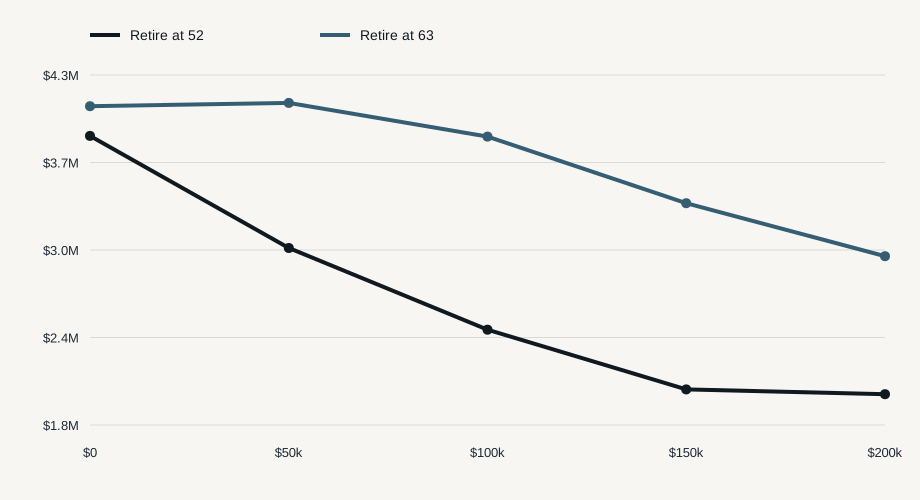
We tested annual Roth conversions of $0, $50,000, $100,000, $150,000 and $200,000 beginning at retirement and continuing through age 74.
The model incorporates federal taxes, ACA premiums and subsidies, Medicare and IRMAA, Social Security taxation, RMDs, investment growth and retirement withdrawals. Excess RMD cash not required for spending or other obligations is reinvested rather than removed from the portfolio.
The Early Retiree: Preserving Capital Won
The results for the 52-year-old were unambiguous. Every Roth conversion strategy tested produced less terminal real wealth than making no conversions.
The $50,000 conversion case is particularly instructive. It accomplished exactly what Roth conversions are intended to accomplish. It dramatically reduced the future traditional IRA balance, lifetime RMDs and income taxes.
Lifetime federal income taxes were approximately $1.34 million lower than in the no-conversion case. Lifetime RMDs fell from approximately $14.1 million to $1.9 million.
And yet the retiree finished with approximately $801,000 less real wealth.
The Cost Arrived Early. The Benefit Arrived Late.
The conversion strategy required taxes to be paid during the years when those dollars had the greatest remaining opportunity to compound. ACA costs amplified the effect.
Through age 64, the $50,000 conversion strategy incurred approximately $324,000 more combined federal taxes and ACA premiums than the no-conversion strategy. The wealth difference consequently appeared long before RMDs began.
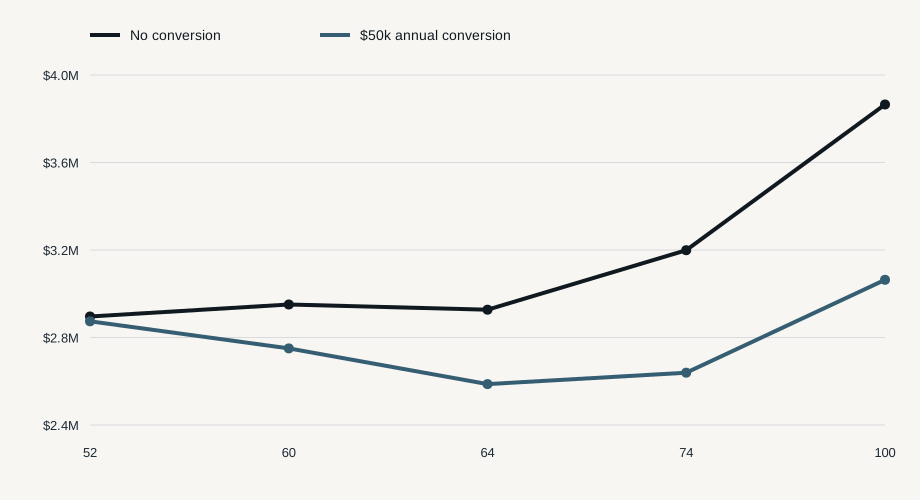
By age 74, the no-conversion portfolio had accumulated a $559,000 advantage in today's dollars.
Then the anticipated liability arrived. The traditional IRA generated very large RMDs and substantially higher taxes.
But it was too late.
The additional wealth preserved during the early years had already compounded sufficiently that the later tax burden never erased the advantage.
The timing of taxation can matter as much as the amount of taxation.
For this modeled retiree, preserving capital during the first decades of retirement ultimately mattered more than minimizing taxes decades later.
RMDs Are a Tax Event, Not a Wealth-Destruction Event
The early-retirement scenario also highlights a potentially misunderstood aspect of required minimum distributions.
Large future RMDs are frequently treated as a major retirement liability. They can certainly create substantial taxable income, increase marginal tax rates, and affect Medicare premiums and other income-dependent costs.
But the entire RMD is not a financial loss.
An RMD is a distribution requirement, not a spending requirement.
If a retiree is required to distribute more money than needed for living expenses, the taxes and other income-related costs represent economic losses. The remaining after-tax distribution still belongs to the retiree and can be reinvested in a taxable brokerage account.
Our model explicitly reinvests excess RMD cash after required spending, taxes and other modeled obligations are satisfied.
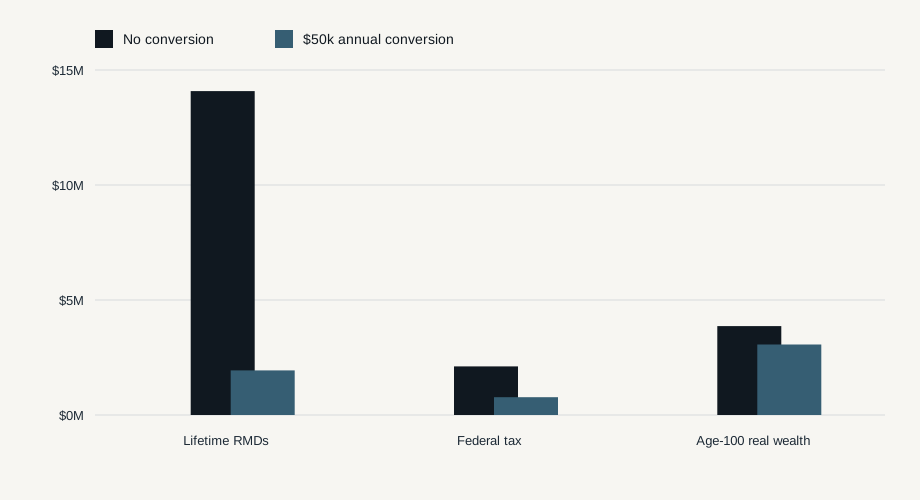
The no-conversion strategy generated more than $12 million of additional lifetime RMDs compared with the $50,000 conversion strategy. It also generated approximately $1.34 million more lifetime federal income tax.
Yet it still finished with $801,000 more real wealth.
Reducing RMDs was successful as a tax strategy. It was not successful as a wealth-maximization strategy.
The 63-Year-Old Produced a Different Answer
The second retiree began with the same $3 million but was 11 years older and held the entire portfolio in a traditional IRA.
Here the results changed.
| Annual conversion | Real wealth at 100 | vs. no conversion |
|---|---|---|
| $0 | $4.077M | — |
| $50,000 | $4.101M | +$24k |
| $100,000 | $3.860M | -$217k |
| $150,000 | $3.384M | -$693k |
| $200,000 | $3.006M | -$1.072M |
A modest $50,000 annual conversion produced slightly greater terminal wealth than making no conversions. More aggressive conversions did not.
The $50,000 strategy initially fell behind, just as it did for the early retiree. At age 74, it had approximately $139,000 less real wealth than the no-conversion case.
But the retiree had only 12 conversion years before RMDs rather than 23. There was far less time for the early opportunity cost to compound.
Once RMDs began, the smaller traditional IRA generated meaningful tax savings. Lifetime federal taxes were approximately $420,000 lower, and lifetime RMDs fell from approximately $10.1 million to $7.6 million.
This time, the later tax savings were sufficient to overcome the smaller early wealth deficit. Barely.
The $50,000 strategy ultimately finished only about $24,000 ahead on a $3 million starting portfolio. A $50,000 annual conversion helped. A $100,000 annual conversion did not.
What Roth Conversions Actually Depend On
These two scenarios do not establish a universal Roth conversion rule. They demonstrate why such a rule is unlikely to exist.
Time matters. Paying taxes at 52 and paying them at 72 are economically different because the capital surrendered at 52 has decades of potential investment growth remaining.
Asset composition matters. A $3 million portfolio containing $1 million of accessible taxable assets behaves differently from a $3 million portfolio held entirely in a traditional IRA.
Conversion size matters. Even in our standard-retirement case, a modest conversion improved the modeled outcome while larger conversions reduced it.
Healthcare matters. For an early retiree using ACA coverage, conversion income can increase healthcare costs at precisely the point when preserving investable capital may be most valuable.
RMDs matter—but their impact can be overstated. The tax consequences are real. The distribution itself is not a loss of wealth.
And withdrawal strategy matters.
During development, our original model used a Brokerage → Roth → Traditional IRA withdrawal hierarchy. That caused converted Roth assets to be spent while traditional IRA assets remained invested.
Changing the hierarchy to Brokerage → Traditional IRA → Roth materially changed the modeled outcomes. This produced an important methodological lesson: Roth conversion strategy cannot be evaluated independently from withdrawal strategy.
It also exposed a broader modeling issue. Our Excel and Python implementations could agree with each other while sharing the same questionable economic assumption. Mathematical replication can confirm that a model is calculating consistently. It cannot establish that every assumption being calculated is economically appropriate.
Taxes Are Not the Objective
Perhaps the clearest conclusion from this research is that three seemingly similar objectives are actually different:
Minimize taxes.
Minimize RMDs.
Maximize lifetime wealth.
They do not necessarily produce the same strategy.
The early-retirement scenario demonstrates this particularly clearly. Roth conversions dramatically reduced both taxes and RMDs while simultaneously reducing terminal real wealth.
Roth conversion economics are a competition between the value of preserving investable capital today and the value of avoiding taxes tomorrow.
Age, asset composition, conversion size, healthcare costs and withdrawal strategy determine which force dominates.
For the 52-year-old modeled here, early capital preservation won decisively.
For the 63-year-old, a modest conversion narrowly won.
Same $3 million. Different circumstances. Different answer.
Methodology & Limitations
The Farenor Roth Conversion Research Model is a deterministic scenario-analysis tool, not a forecast. Results reflect the assumptions entered and should be interpreted as comparisons between modeled strategies rather than predictions of future wealth.
Open Research Model →The model incorporates traditional IRA, Roth IRA and taxable brokerage assets; retirement spending; inflation; investment returns; Roth conversions; federal income taxes; modeled state taxation; Social Security taxation; ACA premiums and subsidies; Medicare and IRMAA; required minimum distributions; and specified withdrawal sequencing.
The scenarios presented here assume constant nominal investment returns rather than variable market returns. Future tax law, healthcare policy, inflation, investment performance and retirement-account rules will differ from modeled assumptions. Brokerage taxation necessarily simplifies the timing and character of investment gains. Individual households may also have deductions, credits, income sources, estate-planning objectives and other circumstances not represented.
The model assumes early access to retirement assets can be implemented where required; detailed SEPP/IRC Section 72(t) mechanics are outside its scope.
The primary outcome used in this research is terminal real portfolio wealth at age 100. It does not assume liquidation of all remaining accounts at age 100.
Research-Use Disclaimer
Farenor provides independent educational and analytical research. This material is not investment, financial, tax, legal, or accounting advice and should not be relied upon as a recommendation to implement any particular strategy.
Model results are hypothetical and depend on the assumptions entered. Individual circumstances and future financial, market, tax and regulatory conditions may differ materially from those represented.